Thursday, June 11, 2020

Soroti Timothy Leadership Training - Manual 1

By Anthony:

A few months ago, I had the joy and privilege of starting a new TLT group in Soroti, the town we live in. It's fun that the church hosting the training, Deliverance Church Soroti, is literally a five minute walk from our home.

This training was very unique compared to my other TLT trainings. This time it was hosted by the Deliverance denomination rather than PAG, and between the trainers and the participants, we had 7 different denominations represented. But we also had some special guests for half of the training, bringing the total number of denominations to 9! This is probably the most ecumenical training or teaching I've ever done. There was a powerful feeling of unity and love for all the group members. There were no doctrinal fights, only good discussions, and everyone really appreciated studying the Bible together.

My co-facilitator was Engolu Joseph, pictured below. Joseph is a seasoned pastor with wisdom and insight, and also a gifted facilitator. But more than that, he is a good friend. He was our student at Pentecostal Theological College in 2009-2010, and he is also the senior pastor of the local PAG church that we worship with.


We had Henk with us from the Netherlands who was connecting with our group for the sake of the research he is doing about TLT for his doctorate program. Two Ugandan pastors from the Presbyterian church also joined him. We had to make some small adjustments to our program for the research but it all worked out really well and Sara and I had a good time getting to know Henk while he stayed at our home during the week.

It was exciting to have Karen and Moses, missionaries in Soroti, join us for the training. They were a huge help in the logistics, budgeting, and food issues. I'm very grateful for their service!  It was also a delight to have two other students that we taught at Pentecostal Theological College back in 2009 as TLT participants, Okiror and Okwi. There were also members from our small group and members from our church participating in the training.


Anne leading devotions one morning:


The first manual is Caring for God's People. We discussed how to make pastoral visits, how to do active listening, how to mourn with those who mourn, how to really get to know church members, how to have humility as a pastor, and how to seek lost sheep who have run away from the church.

Here is a video that shows you a little of the flow of TLT, how discussions go:


One of the discussions was particularly vigorous. In one of the lessons, there was a question about why Christians sometimes fear death. Many of the participants themselves admitted that they fear death. We were able to discern together that there were mainly two reasons for this fear among Christians in Uganda. 1. Many people have not been taught well about Heaven and the New Creation and the resurrection. Because of this, life on earth seems much better than the vague unknown of what is to come. 2. More importantly, we realized that many Christians don't have any assurance of salvation because although they believe in Jesus, functionally they are still believing in salvation by works, and they worry about whether they will be truly saved or not because they know they still struggle with sin.

This led into a quite in-depth Bible study in which I taught a lot about justification by faith and how we receive the righteousness of Christ, and how our punishment is already completely paid for by Christ. It got a little bit tricky at one point because I don't believe a person can lose their salvation, that is to go from being born again to not being born again, while 95% of the participants are from denominations that do believe that. But since I am very familiar theologically with other views about losing salvation (I used to believe that and argue for it myself), I was able to teach how justification by faith still leaves room for believing someone can lose their salvation. Carefully I explained that (even according to the official beliefs of their denominations) someone would lose their salvation by rejecting Christ and walking away from him, but not by accidentally committing one sin. But on the ground here in Uganda, the average pastor believes and teaches that if you sin once you lose your salvation. More theological teaching and biblical study is greatly needed in Uganda.

People were really touched by this discussion, and I had to painfully stop the conversation so that we could finish the manual in time. But at least we spent 1-2 hours on it. I hope and expect that many of them went home with a much better understanding of the Gospel and much less fear of death. A number of people wanted to invite me to their denominations to teach groups of pastors about salvation, justification, and sanctification. I'm excited to do so! Unfortunately those plans are halted for the time being while we are in lock-down because of COVID-19.

Small group discussions:


Each person telling the group about their new action plan:


Praying for the action plans:


This time instead of typing out some of their action plans, you can read them for yourself! I've removed their names for privacy. There are some very unique plans this time!


Thursday, May 28, 2020

Lots of Fun Pictures

By Sara:

Many of these pictures are old, some are new.

It's hard to tell, but this is a picture of a driver's training vehicle being towed by a tow truck.  I'd be seriously afraid to be a driving instructor in a city like Kampala.


More scenes from the road in Kampala:


Apparently Chris Evans is a musician in Uganda:


Check out the trucks full of chickens:


A stuffed animal vendor:


Cows taking up the road in Soroti (on their way to a market outside town the next day):


From our yard:


If you look at this sign very carefully, you are guaranteed to smile:


And what's a fun picture post without some cute animals? (These rabbits are already all grown up and there are brand new babies)


These chicks have also all grown up at this point...


Pictures and video of a baby gecko


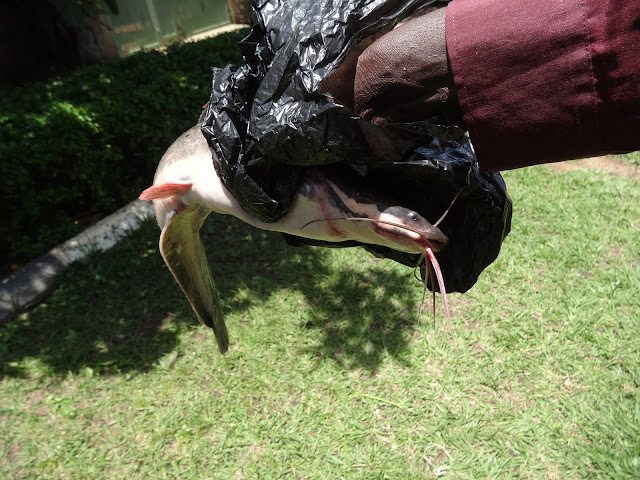
A neighbor was selling mudfish which they raise, so we bought some for lunch one day.


Here is Beorn hiding in the bushes


A sign at a borehole in Soroti telling people to wash their hands before using it to pump water:


Book Recommendation - The Great Influenza by John Barry

By Anthony and Sara:

We both recently read The Great Influenza, by John M. Barry, and would like to recommend it during this time of crisis due to Covid-19. It is a timely topic to read about and both of us found the book very educational and interesting.  There is so much we can learn from history. It's long and a bit technical in some places, but well worth persevering through.

I, Anthony, really enjoyed learning about the individual doctors, not only about their work, but about their lives, and how they persevered through trials to finally make groundbreaking discoveries. It was also really interesting learning about World War I and all the failures of our government during that time. I was shocked to learn about the amount of lying and propaganda and suppression of freedom of speech by the American government.  Here's a quote relating to that:

"In 1918 the lies of officials and of the press never allowed the terror to condense into the concrete. The public could trust nothing and so they knew nothing. Society is, ultimately, based on trust; as trust broke down, people became alienated not only from those in authority, but from each other. So a terror seeped into the society that prevented one woman from caring for her sister, that prevented volunteers from bringing food to families too ill to feed themselves and who starved to death because of it, that prevented trained nurses from responding to the most urgent calls for their services. The fear, not the disease, threatened to break the society apart."


In addition to the book, it is very interesting to read John Barry's remarks about the current covid-19 crisis.  You can read or listen to an interview with him here: What The 1918 Flu Pandemic Can Tell Us About The COVID-19 Crisis

I, Sara, thought the background information on the development of "modern medicine" in the United States was particularly interesting.  I had no idea how far ahead Europe was compared to the US in the late 1800s in terms of understanding the way diseases spread and how to treat them.  The US was still bleeding patients and many medical schools allowed students who failed many courses and who had zero experience working with an actual patient to graduate with a medical degree...  Basically, we can be grateful we live in a time when doctors are much more qualified and knowledgeable about how to care for sick people.

Who knows how these would work out in reality, but the author's recommendations based on attempted quarantines and use of masks during the 1918 pandemic (and written prior to the Covid-19 outbreak) are thought provoking:

"One tool of no use is widespread quarantine. For some diseases quarantine makes good sense, and in theory in some circumstances it could help even for influenza—but only in theory. An unpublished 1918 study of army camps demonstrates this. The army had data on 120 training camps—99 imposed quarantine and 21 did not. But there was no difference in mortality or morbidity between camps implementing quarantine and those that didn’t; there was not even any difference in how long it took influenza to pass through the camp. The story, however, isn’t quite that simple: the epidemiologist who performed the study looked not just at numbers but at actual practice, and found that out of the 99 camps that imposed quarantine, only a half dozen or so rigidly enforced it. Those few did benefit. But if the overwhelming majority of army bases in wartime could not enforce a quarantine rigidly enough to benefit, a civilian community in peacetime certainly could not. Closing borders would be of no benefit either. It would be impossible to shut down trade, prevent citizens from returning to the country, etc. That would shut down the entire economy and enormously magnify supply chain problems by ending imports—including all health-related imports like drugs, syringes, gowns, everything. Even at that, models show that a 90 percent effective border closing would delay the disease by only a few days, at most a week, and a 99 percent effective shutting of borders would delay it at most a month."

"Surgical masks are next to useless except in very limited circumstances, chiefly in the home. Putting a mask on someone sick is most effective because it will contain droplets otherwise expelled into the room—a fact that experiments in 1918 proved. Will a parent put a mask on a sick child and make that child more uncomfortable? Maybe, if he or she knows it will protect the rest of the family. And even a surgical mask when combined with rigorous hand washing may provide some protection for those in close contact with a sick person. N95 masks would be more appropriate in that situation and they do protect, but they need to be properly fitted and properly worn. This is harder than it sounds. A study of professionals wearing N95s to protect themselves from toxic mold found that more than 60 percent did not wear them properly. In addition, they are extremely uncomfortable. For a few individuals and situations N95 masks may make sense, but for the general public over a period of weeks they do not."

Of course, this book is about influenza, rather than coronavirus, but we can still learn lessons from the actions of people and countries in the past.  So, if you like science and history or are interested in epidemiology, this is the book for you.

Thursday, May 14, 2020

New Radio Teaching Ministry

By Anthony:

As many of you know, I've been able to preach periodically on the radio over the past two years, at the invitation of my friend Richard Okiror, an elder from PAG. He is the one who first taught me about radio ministry. But together Richard and I are expanding the radio ministry he was already doing, together with some young people from our church who are translating for us and also helping us communicate with, counsel, and pray for all the listeners who call us after the broadcasts. Richard is on the left in the picture below.


Here is Moses, one of the translators on our team. Simon is also on our team, but not pictured.


Richard and other pastors continue to preach on Thursday mornings, but now we have started a teaching program every Saturday evening, from 6-7pm East Africa Time. Rather than preaching, the Saturday evening times are for teaching on deeper topics. We believe teaching over the radio is a powerful and effective way to teach church leaders and disciple and equip church members for ministry. Radio is very popular here especially since most of the population does not have easy access to the internet or smartphones.

You can listen to us live any Saturday if you want to Here. The broadcasts are not recorded, so you have to be online at the exact time. Saturday evenings are the best time to have our radio program according to our friends and church members here, as people are sitting around together at home, and they can listen while relaxing or while preparing their evening meal. We are grateful to the radio station for giving us the exact time that we wanted.

We use ETOP radio station, 99.4 FM, which is the most prominent and listened to station in our region. It primarily targets the Teso region of Uganda, and so we translate everything, so that people hear both English and Ateso. We have notified pastor contacts around the country so that they can help spread the Word to people to regularly listen to our program. It's been fun having friends call me after each radio broadcast, some of whom I haven't seen in years.

Our teaching program is unique. I’ve been told by Ugandan friends that many pastors from various denominations preach on the radio but their messages are often not very deep, not very biblical, and very repetitive. Unfortunately many of these preachers simply preach the prosperity gospel every week. So on Saturday evenings we are giving theological teaching. People are hungry for knowledge and for God's Word. Unfortunately, the church culture sometimes makes it seem like theology is a secret reserved for pastors. We will teach on deep topics, but slowly and carefully in a simple to understand way. Possible topics could include: theology, justification and sanctification, mission and evangelism, church history, poverty, alcoholism, caring for people with disabilities, pornography, spiritual disciplines, marriage, and more. Since we are in a time of crisis, I have been teaching about the role of suffering in the Christian life and God's providence.

I will be the usual teacher in the Saturday evening time. But once life returns to normal, I will be away half of the time at meetings and trainings, so other pastors from Soroti that we work with will be invited to teach on various topics whenever I am not there.

I'm also indirectly trying to combat the false teachings, false prophecies, and fake news articles that are spreading widely throughout Uganda by social media and word of mouth. It makes me furious how easy it is to create a simple social media post from scratch, something that sounds true but isn't, and then it spreads to millions of people within a few weeks. And some of these fake articles not only create widespread fear and panic, but they could cause people to make foolish decisions that will result in their deaths (such as trying to cure covid-19 through hot water and lemon, or refusing to take any vaccines for anything).

We receive questions at the end of each broadcast, and answer those questions at the beginning of the next broadcast. We also give optional “homework assignments” that people can do for follow up study or application. We will also suggest action plans or have people call in live to suggest possible action plans to be done as an individual, family, church, or community.


We have already seen very good results from this ministry including people calling us to commit their lives to Christ over the phone. We then try to connect them to churches we know or local churches in their area for follow-up and discipleship. Or people call to appreciate us and ask for prayer. Just in the past two weeks, I have received around 20 phone calls. I counseled a woman who was suffering from domestic abuse from her husband, counseled a young man who is struggling with sexual addiction, counseled a woman whose husband is being unfaithful, and prayed for a man who was suffering from spiritually oppressive dreams.

My other team members as well as our guest preachers receive far more phone calls than I do since they can talk to people in Ateso. We receive calls from PAG members (Pentecostal Assemblies of God), but also people from Catholic or Anglican churches, as well as people who don’t go to church at all. Here are a few (of the many) testimonies so far:

- Thank you so much dear pastors. May God bless you all. The word has really inspired my life. We give him all the glory for what happens. Continue to build us spiritually.”
- A retired bishop called and said that this was the first time he had ever learned about the doctrine of providence after a lifetime of ministry. He wants to now emphasize it in his preaching.
- One person was prayed for who needed healing and called again to testify that right after that, he was healed!
- A lady called and said our program has changed her family already. Her husband was an alcoholic, and now he has stopped drinking. He continues to listen to our program and she is waiting for him to get saved.
- Pastors are calling and saying our program is equipping them and giving them strength. They say that God took us there for a purpose.