Thursday, December 17, 2015

Last Kaberamaido TLT - Work and Worship

Recently, I finished my last week of Timothy Leadership Training in Kaberamaido with the help of Baker, Betty, and Agnes.  It was a hectic week.  I had to learn to get over my perfectionism and impatience in the midst of many distractions.  There was a meeting some development team staff had to go to, there were multiple burials that many of the pastors had to attend, and then on Wednesday we had to cancel half of the day because the president of Uganda came to visit Kaberamaido as part of his campaigning.  But even with these disruptions, the training went on well and they learned a lot.  We completed the manual, "Serving God in Work and Worship" which you can read about in my Amuria post.


It was nice to hear reports from last manual of Sunday school teachers being trained and Sunday Schools being started.  Unfortunately many of them did not complete their action plans that they set out to do.  I think fatigue is starting to set in since we've been meeting for TLT every 3 months and then they do action plans after each one.  (Keep in mind they already are extremely busy in their day jobs of being farmers, and in their normal ministries).  Now that we are finished, they are going to make sure in the coming months that they complete their old plan from manual 5 ("Teaching") as well as their new one for this manual, "Work and Worship."


Here are some of the topics we discussed that I found interesting:
  • What does it really mean to say "Praise God!" while preaching?  When should we use it and when should we not?  Is it better to say "Amen!?" instead?  Are people giving praise to God in the middle of the sermon when we say it?  Or is just a habit that we say it?
  • We had a discussion about how so many Christians or even whole Christian families do not own a single Bible.  I asked if people had money to buy them.  I was told that most people do have money to buy them, but it's a matter of priorities.  They said people would rather spend that money on airtime, school fees, or other things they want.  Many people are waiting for a missionary to give them a Bible and so they spend their money on other things instead.  And then some people don't really have an interest in reading.  I'm not making up these answers.  This is what I was told by a whole group of pastors.  Let's be more cautious in handing out Bibles.  It can create dependency rather than good stewardship.
  • We had a long discussion about confession, and whether and when it's good to share about our sins to other people.  One lady said, "the problem is, when you tell someone about one of your sins, someone will call you on the phone and tell you about it before you even finish the conversation!"  Meaning that it's hard to find people who you can trust who won't quickly share the information with others.   A lot of people have got themselves landed into church discipline when they shared their struggles with someone who was not good at being confidential.
  • We had some discussion about worship wars.  Here one of the struggles is new music from America versus traditional local language songs.  Also, another struggle is that many churches are moving to using a keyboard instead of the traditional instruments of Ugandan tribal cultures.  Some of the skills to play these instruments are slowly dying out.  And the older Christians aren't all big fans of the super loud electric keyboard with speakers.
  • We discussed the lyrics of many popular worship songs in Uganda, and how some of the lyrics have little to no meaning, such as things like, "now we are all clapping, now we are all dancing," etc.  They are excited to write new songs, and use the Psalms as inspiration.
  • We discussed baptism.  This time a pastor pressed me to find out my view on baptism and what my denomination does.  I was hesitant to share but didn't have a lot of choice.  I informed my Pentecostal brethren that I was baptized as an infant, and I was sprinkled, and gave a very brief explanation of why we do that.  For many of them, these practices are clearly wrong and I've heard Pentecostal pastors here in Uganda say people aren't saved who practice baptism this way.  So I was hesitant to share.  But I was very glad to find that they didn't condemn me, and in the end I think it was good for broadening their understanding that you can be brothers and sisters in Christ even with differences of belief on important things.
Here are pictures of praying for new action plans:


Some of their new action plans:
  • Most people are going to train their fellow pastors and worship leaders in this new manual.
  • One pastor is going to make sure he and his family rest one day a week (something that most of the pastors thought would be impossible, even if God did command us to rest).
  • One leader is going to plant 200 trees to help show people in his community the value of work.
  • One pastor is going to teach his church about confession and start a practice of communal prayers of confession.
  • One pastor is going to teach about the value of hard work as a way to glorify God, and hopes to see a 10% increase in church offerings.
  • Some worship leaders are going to write new worship songs for use in church.
  • A couple pastors are going to teach their church how to keep pigs and chickens so that people can increase their incomes.


Wednesday, December 9, 2015

December Prayer Letter

Enjoy our new prayer letter.
You can access it at this link - December 2015 Prayer Letter

Wednesday, December 2, 2015

Keyhole Gardens

By Sara:

Well, I finally used up all those empty plastic bottles I had sitting behind our garage for months and months.  The following story will explain how I got to that point.

When we went to Tanzania for our World Renew East Africa team meeting, we got to visit a farmer who has been doing all sorts of interesting things with farming.  On a small amount of land, he has been able to earn enough money to send his children to school and university!

He is growing vanilla, which is a very marketable product, but one which you have to work really hard to grow - each flower needs to be hand-pollinated if you want any vanilla beans!  He also has biogas from the manure of his few animals.  And his gardens were just incredibly beautiful and well maintained.  I hope that someday I can have as beautiful of gardens.


Here's one of the beds that he had just prepared and planted seedlings in:

But anyway, on to his innovations, he had sack gardens.  This is something that I tried in my garden, but it didn't work so well.  My sack disintegrated in Soroti's hot sun in not very many months.  But his were great:


He also had keyhole gardens, raised gardens that have a ring of sticks in the middle, filled with manure and grass.  There is also a "keyhole", a notch in the shape of the garden so you can step in and reach the middle.  You pour water from washing or bathing into the middle where the manure is and as the water goes in, it spreads out to the rest of the garden, bringing nutrients to the plants.


So anyway, I was inspired.  It seemed like a good way to use all my plastic bottles - in building the sides and filling in part of the middle of a keyhole garden.  Here's my keyhole garden as I built it (not as pretty as his, but we have to start somewhere, right?)


And here it is as things have started growing:


Steaming Cakes and Skillet Baking

By Sara:

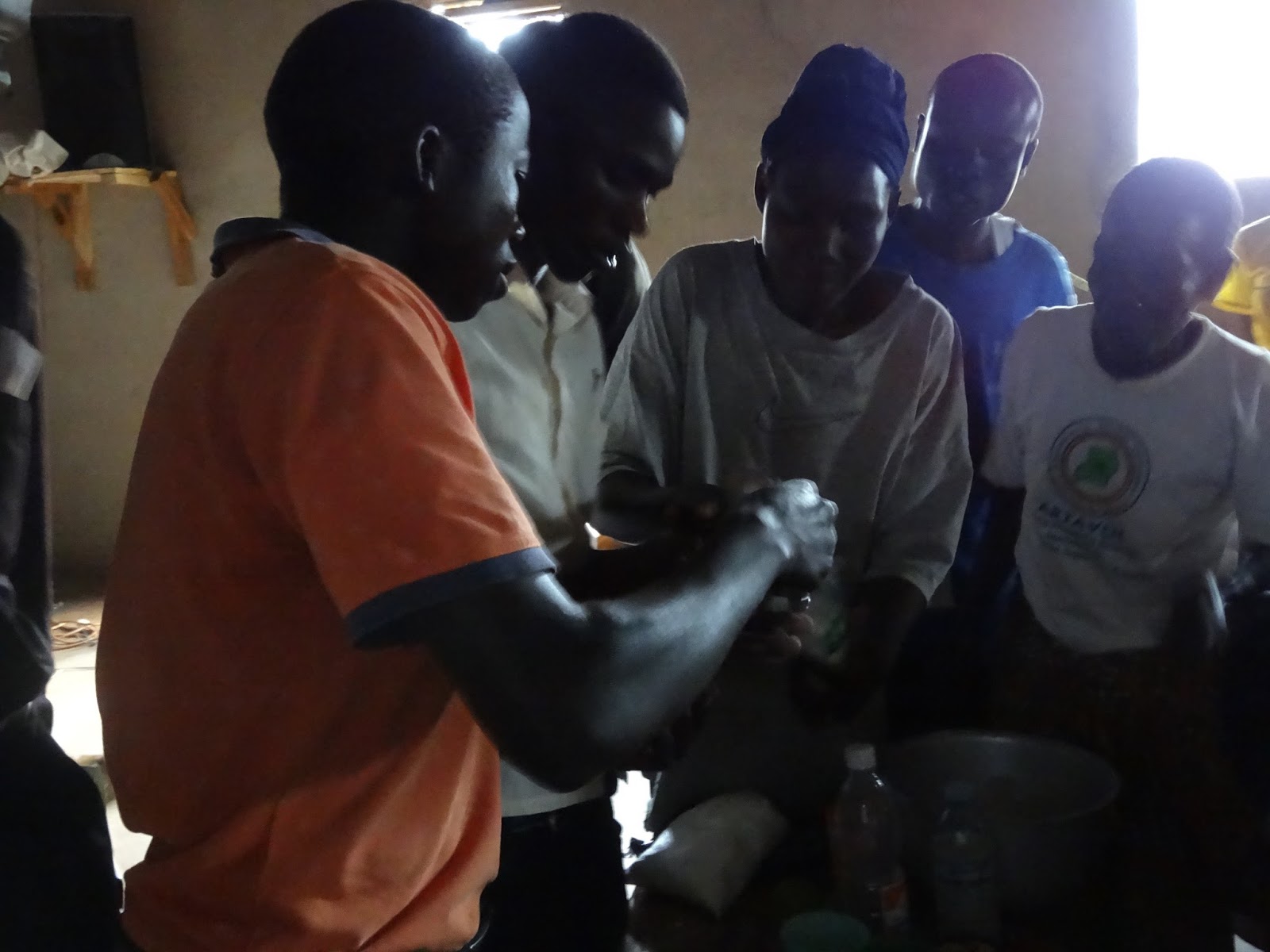
Our friend Emmanuel, who is a pastor in Anyara, has been transferred to a different church, in town.  So he asked me to come and teach people in his new church about baking.  I have gone there twice - once to teach how to bake cakes by steaming them and a second time to teach how to bake things like scones and biscuits on a frying pan.  I forgot the camera the first time, so no pictures of baking cakes.  And the second time, there was a wild thunderstorm while we were baking, so the pictures are kind of dark.  But they are there!


There were a lot of youths who came to the trainings and they were very eager to learn baking skills.  It was very fun teaching this group because they are all so enthusiastic and willing to experiment.  When I came back for the baking on frying pans training, I learned that they had baked a cake after the previous training and used it for the bread in Communion at church!


It was also fun sharing how you can use old bananas to make banana cake and cooked sweet potatoes to make sweet potato biscuits.  Some people were also surprised to discover that you can make breads on a frying pan without coating it in oil.  The breads people make most often here are chapatti and mandazi, both of which are very fried.  So it is exciting to find that you can make tasty (healthier) breads even without an oven.  (It is also cheaper when you eliminate the ingredient of oil).


Here are some cheerful participants holding the instructions for their friends.


This church is right next to a school, so there are always crowds of school children who come in during their breaks (recess? lunch?) to see what is going on, and, of course, to taste the food once it is ready!