Thursday, February 12, 2015

Book Review: The Poisonwood Bible

This year I started reading books together with my friend who is also the pastor of one of our supporting churches.  We read a book each month and discuss.  The first book we read together was The Poisonwood Bible.  I thought I'd give you a few thoughts about the book in case you were considering reading it.

First of all, it was a very interesting book.  It is set in the Belgian Congo, what is now the Democratic Republic of Congo, and is about the life and ministry of an American missionary family.  The book is well written, with interesting unique characters, interesting events (both personal and political), and it really gives you a whiff of the rich aroma of African life, down to gritty details.

Even though the book's setting is roughly 50 years ago, I was amazed at how many commonalities there are between the missionary life then and our lives in Uganda today.  We are still stared at and people still ask us for stuff every day, which is surprising since mzungus have been in Uganda for 100 years.  The book also reminded me again about certain things I love about African culture, and things I find disturbing and wrong.  Just like there are things I love about my own culture, as well as things in it that I find disturbing and wrong.


The book is very challenging regarding political and economic issues (though perhaps a bit anti-American).  It was convicting thinking about the role the USA (and other Western countries) has played in the destinies of other countries.  It's probably far too easy to judge our leaders for past events in hindsight, and yet, it is profoundly disturbing to think of the ways we have messed with the leadership of other countries for our own ends, especially because in some cases this has caused great poverty, corruption, or violence.  The book is of course fiction, but it parallels much that has really happened.  The book inspired me that as one very small voice, I need to do what I can to help my country act justly. 

I started thinking that if I can't control the huge large scale problems my country and other countries are causing, at least I can try to make a personal difference.  In the book, at times the individuals of the missionary family are at odds with the actions of their home country.  I think the same is true for us today.  The USA is a very generous country and is trying to help other countries, but often the giving is done unwisely and can increase corruption or dependency.  So as in the book, sometimes I feel like my country is doing great harm on a large scale, while I'm trying to do the opposite on a very tiny scale.  That can be quite depressing.

One of the main themes of the book is a very critical look at the pastor missionary father of the family.  In my opinion, he is an extreme caricature, as opposed to the other characters which are mostly balanced and believable.  I'm not saying that there never has been a pastor like him.  I'm sure there has been, but they must be an extremely small percentage.  He is abusive, racist, foolish, uncaring, unloving, hypocritical, prideful, selfish, and ridiculous in his missionary methods.  It was painful to read and I kept wanting to shout, "Not all pastors are secretly abusive and unloving!"  My concern is that the book perpetuates an offensive and inaccurate stereotype of pastors and conservative Christianity in general.  Most Christians I know are very loving, not hypocritical, and up front about their weaknesses.

I am also concerned that the book gives a false impression of real Christian mission work.  We live in a culture in which tolerance means pretending we all believe the same thing, and that love means not telling someone they are wrong about something.  We live in a culture in which trying to convert people is seen as intolerant, oppressive, and even hateful.  As I strive to help people see why missions is actually a loving thing, this book could work against me.  The author in a way sets up a straw man argument, a terribly intolerant (in the real sense of the word) racist example of mission work.  Such an example of missions makes it easy for anyone to criticize missions as oppressive and intolerant.  Even I, after reading the book, thought for a second, "should I even be a missionary?"

But the truth is, most missionaries today, are not like him in the least.  Missionaries are careful and culturally sensitive and not trying to take Africans out of their culture.  Missionaries are not doing their work to get a scorecard of converts.  They are sharing their faith with other people because they have experienced God's love through Jesus, and they cannot help but share that love with other people.  To not share how to have a relationship with God would be the most hateful thing to do.  See this old post for more on that.  Thinking about all of this, in some ways the book seems very anti-Christian, though it's possible that was not the author's intent, and maybe it was intended as a helpful correction to the errors of some Christians.

In the end, I would heartily recommend this book to young missionaries who are passionate in their faith and excited to do mission work.  Such a book will give them good challenges to work through regarding their faith, missions, culture, and politics.  And they will find it an enjoyable, if somewhat depressing, story to read.  Hopefully reading it would help reveal to them any ethnocentrism or racism that they might not realize they have (most of us have these to at least some extent).  And it's a book that helps us to think through the difficulties of presenting the Gospel in new cultures.

I am very glad I read the book.  It was a book that was hard to put down because it was so interesting and the characters were so colorful.  It was a book that made me think.  Yet, because of the above, I recommend it only with some qualification and caution.  If any of you do go out and read it, let me know what you think of it!

Wednesday, February 11, 2015

Conservation Agriculture Near Anyara

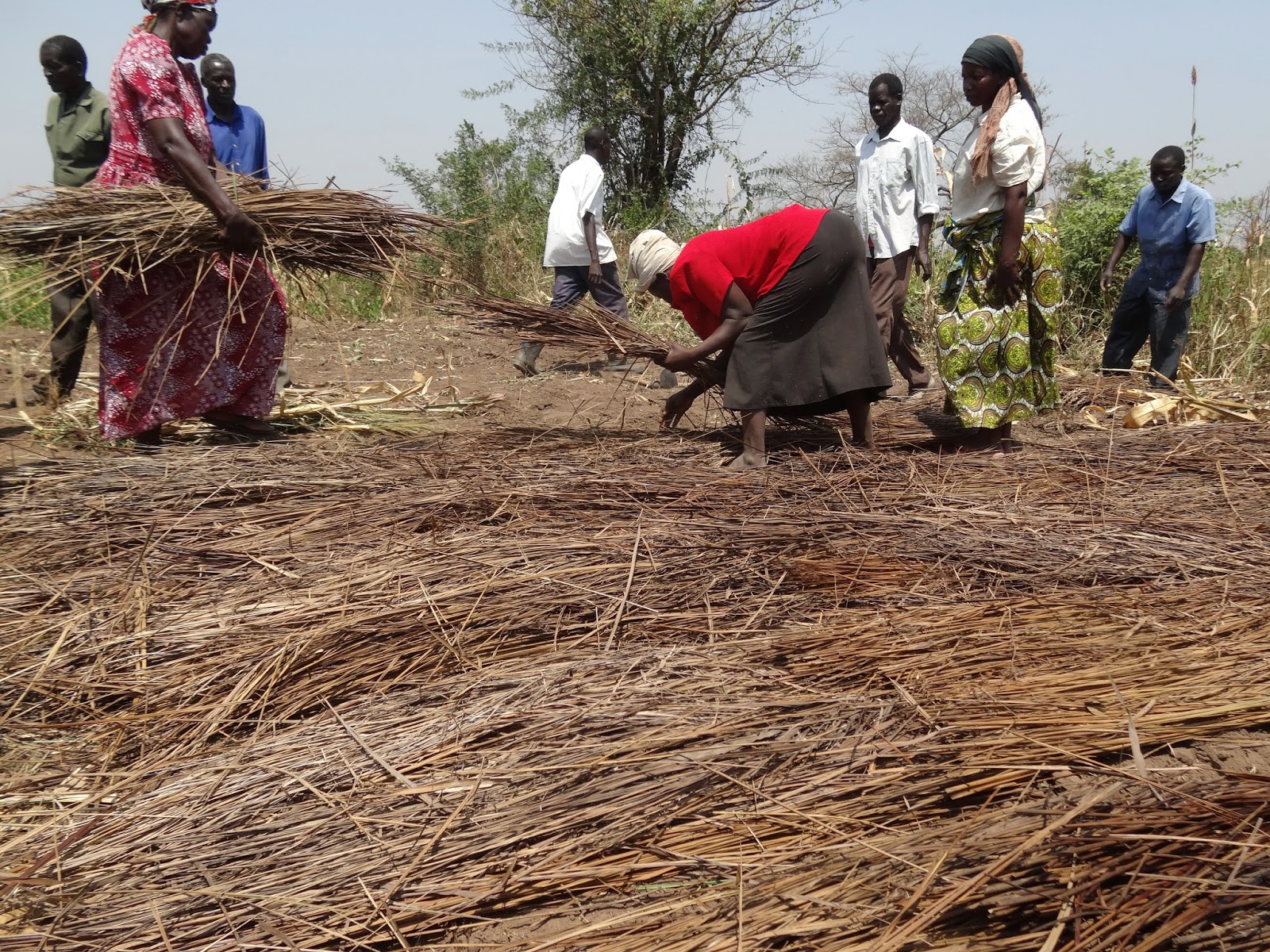
I had the fun opportunity to do a conservation agriculture training in a village church near Anyara, with one of our many friends named Emmanuel.  We spent one day talking about the theory - why it is helpful to try not to disturb the soil much, to keep soil covered, and to rotate crops.  Then, we spent another day preparing some demonstration gardens right next to the church where people will get to observe them.

We practiced using our hands to make measuring sticks and then marked out the spacing for planting on a rope.


Since it is the dry season, it was very dusty when we cleared the garden space.


Normally, we would leave a tree stump in a big garden, but we wanted to be able to compare the control plot with the conservation agriculture plot (without extra variables), so some guys took out a tree stump that was in the middle of one of the plots.  Emmanuel is the second from the left in the white shirt.


We took a group photo and plan to take another one later, when things start growing.  We can't plant until the rains start (probably in March), but everything is prepared and ready for planting.


Another cool thing about this training is that one of the participants is an organic farmer who had some materials about organic pesticides that he shared with the group.


He went out and found some of the indigenous plants that you can use and showed them to everyone as he explained the process of making pesticides with them.


Wednesday, February 4, 2015

Katakwi TLT - Christian Stewardship

I just got back from a week of Timothy Leadership Training in Katakwi.  It was very hot!  So hot that the pastors were complaining each day about it and fighting off sleep.  I was uncomfortable myself sitting all day with my clothes thoroughly soaked in sweat.  It is the dry season.  Each night of the training I slept in a 90 degree room with no fan (and had to listen to cocks crowing and Muslim calls to prayer throughout the night).  But regardless of such challenges, it was a very successful training.  Here is a video of morning worship.


As usual when the pastors reported on their previous action plans, there were powerful stories of transformation.  Many people got saved, families were reconciled, and even a health center was thoroughly cleaned by 24 church members, toilets and all.  It was a powerful witness to the community.
However, there were many action plans that were not successful.  You need to please pray for these leaders who are attending all of my TLT trainings.  I am certain that Satan is throwing up roadblocks to hinder these actions plans.  This Katakwi group is small, but in this group some had unsuccessful plans because of financial challenges, because church leaders refused to be trained, because a pastor's bicycle was stolen, because a pastor got very sick, and because a pastor got into a motorcycle accident.  Pray for them.


This time Lazarus could not come and be my co-facilitator, because he was on his honeymoon after just getting married!  But Baker came and helped me instead.  You may have read about him in Sara's recent post.  He is a gifted leader and was a huge help to me especially with translating.  His testimony is very interesting.  For example, I learned that he used to be part of the Arrow Boys, the local militia that fought Joseph Kony and the LRA near Soroti.  He is a very strong Christian leader and is doing important ministry as you can see from Sara's blog post.


I won't go into much detail about what we learned in this manual, as I've already told you in two other posts.  If you need a refresher, here are the links -  Amuria TLT - Christian Stewardship.  
Kaberamaido TLT - Christian Stewardship.

This TLT group is only about 18 people but that makes for very interactive discussion and people being able to talk much more than if they were in a large group.  I was privileged to have my World Renew supervisor, Edward Etanu, join this group.  It was funny helping him write his action plan one minute, guiding him what to do, and then the next minute during a break he was telling me about some things I have to do.  Not everyone is blessed to have such a humble supervisor.


A few Ugandans have beards like me, but not many.  This pastor says he knows most Ugandans think facial hair is scruffy looking, but he and his wife like his beard!


One leader, Tom, is a treasurer of his church, so he helped me by writing some example budgets to teach the students how to budget.  About half of the churches represented had never written a budget of any kind.


Here is Baker and a pastor helping an older women's leader who has trouble reading English.  The women's leader is 65 years old, but has the strength of a 30 year old.  You are never too old to learn.


I felt very loved this TLT as I was sent home with a monstrous bag of G-nuts (groundnuts, that is peanuts) from one student, and the women's leader above gave me a bottle of oil from the shea-nut tree.


Above and below you see students with their action plans. 
  • This time most of the plans were about planting trees at churches.  
  • Another leader has a plan to take care of his body through exercise and diet. 
  • Another plan involved cleaning a local health center. 
  • One pastor plans to train 7 church treasurers on report writing. 
  • Another pastor hopes to see the giving increase at his church by 10%. 
  • Another pastor, Richard, plans to train 6 pastors in the whole Stewardship manual. 
  • An elder has a plan to give all 12 pastors in his assembly some time to rest (as they are all extremely overworked with almost no rest ever).  He is going to make sure they get a two day un-programmed retreat with their wives at a guesthouse. 

Pictures of Caleb

I've been saving up some fun pictures of Caleb to show all of you.  This is where Caleb is every day from about 10:00am to 4:00pm, when he is wiped out and sleeping.  It's hard to walk out the door!  We let him in the house sometimes too but generally he doesn't come in without permission.


Okay this one isn't Caleb, but still a fun pet picture.


Below are pictures of Caleb getting neutered in our yard.  As I said on facebook - "hopefully this will cause him to stop trying to reproduce with our goats trying to create an abnormal mutant dogoat. Such a creature may well be interesting to me, but I don't think Sara would approve."  Well, it was successful.  He is still a super excited crazy dog, but he is no longer mounting the goats.  The surgery was done very professionally and took a few hours for everything, including setup and post examinations.  They used horse tranquilizer so he wasn't fully back up to his normal self until the next day.


We enjoyed having our friend Marissa stay with us for a couple weeks.  She and Caleb really bonded and I'm sure Caleb misses her.


On our walks Caleb finds all sorts of interesting treasures like this corn cob.  He always has to snatch things quickly because I don't let him linger.  Among other things he's picked up and carried: unidentified poop, sticks, rope, a shoe, a doll, and plastic bags.


This could be a result of our sinful nature, but one of the most fun things on a walk is when Caleb sort of jumps at children (who are in no danger whatsoever), and they take off running and screaming.  We have found that children are more scared of a dog on a leash than a dog not on a leash.  It seems the children are usually not terrified but having fun being scared.

Below is Caleb gracefully pooping with all of the fowl in the yard coming to eat it up quickly.  It also works the other way around.  Caleb runs to eat the chicken poop as soon as it drops.  And don't forget the goats and their poop.  As you can see, we don't have to do a lot of picking up of poop in our yard.  And we don't let our animals lick our hands....


Below are some pictures of a hill in Soroti we walked up with Caleb.  It's not the famous "Soroti Rock" but it still gave us a good view.  Our house is somewhere in the trees yonder.


Soroti Rock in the distance.


A man and his faithful dog.